Gold, Geopolitics, and the Market
January 26, 2026
Geopolitical narratives tend to shift quickly. Venezuela dominated attention one week, only to be replaced by concerns around Greenland the next, and it is likely that another flashpoint (probably Cuba) will soon emerge. These episodes often follow a familiar pattern: heightened rhetoric, brief market volatility, and eventual normalization. Markets sell off, recover, and move on to new highs.
A useful way to frame the current environment is this: the world is increasingly being pulled into a strategic competition between the United States and China, particularly in technology and artificial intelligence. For countries in the middle—Canada, Europe, and much of the emerging world—this dynamic can feel uncomfortable or destabilizing. But from an investment perspective, what matters most is not ideology or rhetoric, but the economic consequences of this competition.
Both the U.S. and China are committing enormous resources to win the next phase of technological leadership. Trillions of dollars are being directed toward artificial intelligence, semiconductor manufacturing, automation, energy infrastructure, defense, and supply chains. This is not a short-term cycle; it is a multi-year industrial buildout.
The implications for markets are significant and positive.
First, I expect continued strength in areas directly tied to real-world investment and production. Commodities, energy, and materials benefit from rising demand for physical inputs. Semiconductor manufacturers, memory producers, and automation companies are positioned at the center of the AI buildout. Defense and security spending remains structurally supported by ongoing geopolitical uncertainty. Infrastructure and industrial companies stand to benefit from reshoring, rebuilding, and large-scale capital projects. Emerging markets, particularly those rich in natural resources, may also benefit from these trends.
Second, we are more cautious on assets that are sensitive to rising inflation or higher interest rates. Long-term bonds remain vulnerable if government spending and economic activity stay elevated. Highly speculative or unprofitable technology companies—whose valuations depend heavily on cheap capital—are also more exposed in this environment.
At the same time, we are mindful of an important countervailing force: technology itself can be deflationary. Productivity gains from AI and automation could eventually lower costs and suppress inflation, even amid heavy spending. This is a risk that I feel economist are underestimating, and it is something I am watching closely. If we see deflation rather than the widely expected inflation, it will give the central banks the excuse to lower rates sooner which generally benefits the stock markets.
Many clients have been asking about the recent rise in gold and what it means for portfolios. There are several well-known reasons behind the move. Geopolitical tensions have increased, and central banks around the world have been gradually reducing their reliance on U.S. Treasuries and adding to alternative stores of value, including gold. These trends have been developing over time, so the strength in gold is not entirely surprising.
At the same time, it’s important to put the move into perspective. Gold was roughly $2,500 an ounce around this time last year and is now closer to $5,000. Silver has also risen sharply (over 300%) over the same period. Buying gold aggressively at this stage means doing so after a substantial run-up. That doesn’t mean gold cannot continue to rise—there are still valid reasons why it could—but the balance between opportunity and risk looks different than it did earlier in the cycle.
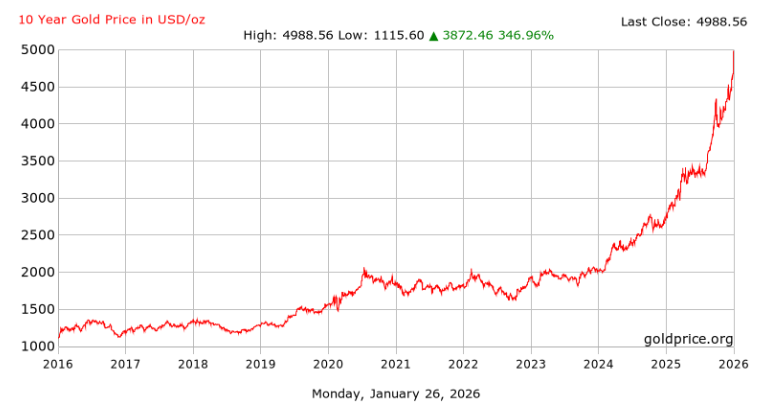
From a portfolio standpoint, our approach is measured and disciplined. We remain overweight precious metals, but our positions have grown significantly so it makes sense to rebalance and redeploy some capital into other areas that appear more attractively valued. In our pools, particularly the Diversified Pool, gold has contributed meaningfully to performance over the past year.
However, after such significant gains, disciplined positioning matters more than chasing momentum.
In short, while headlines change rapidly, the underlying story is more stable: a global race to build technological and industrial capacity is reshaping capital allocation. Our portfolio decisions are guided by these structural trends rather than day-to-day political noise.
We will continue to adjust portfolios thoughtfully as conditions evolve, with a focus on balancing opportunity, risk, and long-term objectives.
I also discussed silver’s recent surge in price on CBC—that interview can be heard here.
As always, please reach out if you would like to discuss how these themes affect your portfolio in more detail.
Best regards,
Mark Ting